What Happens When Software Starts Designing Itself Around Us?
From mobile games that predict our behavior to AI-generated interfaces, a look at how software is changing and what it could mean for education.
Your school’s learning management system might know how many assignments a student has completed, how often they’ve logged in, and which courses they’re taking.
Meanwhile, a seemingly harmless puzzle game on their phone might be using their behavior to predict exactly how to keep them playing.
There’s something a little strange about that.
I recently came across a reverse-engineering analysis of Block Blast, a mobile puzzle game that looks remarkably simple. You arrange colorful blocks, clear rows, and try to beat your previous score.
But according to the developer behind the analysis, @ayoships, the game may be doing considerably more behind the scenes, potentially using behavioral signals and predictive models to influence the player’s experience.
Some of those claims, particularly around manipulating gameplay difficulty and advertising behavior, remain unverified. Still, the investigation led me toward a much bigger question.
Consumer applications have spent years learning how we interact with them. As AI advances, could that information eventually allow software to redesign the experience itself?
And what might that mean for educational technology?
The Applications That Learn From Us
Duolingo offers a well-documented example of behavioral personalization.
In a 2020 engineering article, the company explained how it uses machine learning to determine which practice reminders are most likely to encourage individual learners to return.
The system experiments with different notifications, observes responses, and learns which approaches are more effective.
What’s interesting isn’t the notification itself. It’s the feedback loop.
The application observes behavior, makes a prediction, acts on that prediction, and measures what happens.
This kind of personalization has existed in consumer technology for years. Recommendation engines, adaptive games, and experimentation platforms frequently use behavioral information to optimize experiences.
But historically, many of those adaptations have involved choosing between options developers created in advance.
AI is beginning to challenge that limitation.
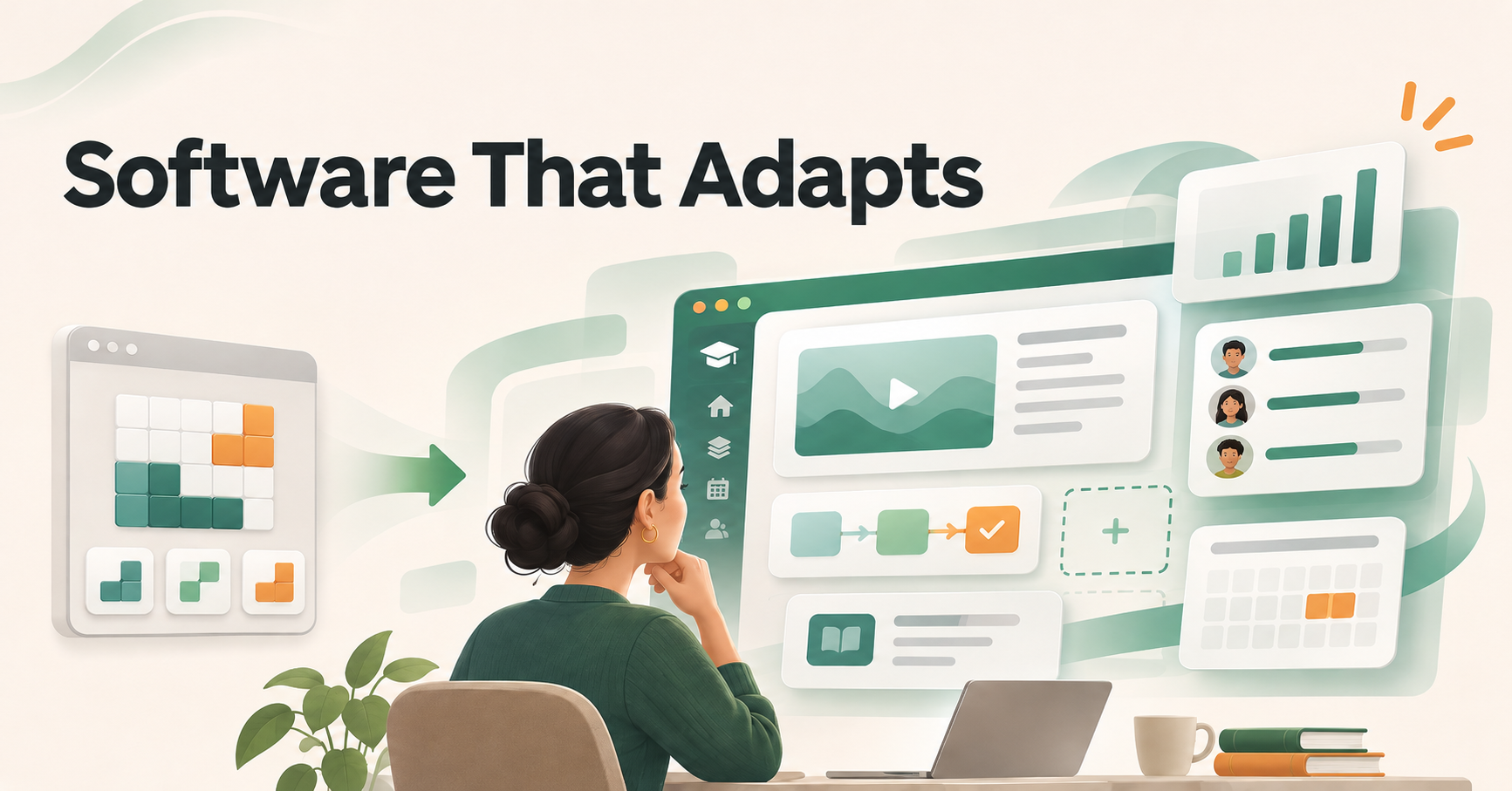
Software is becoming capable of generating new interfaces and interactions around what someone is trying to accomplish, rather than simply selecting from predefined screens.
That’s where the story takes an interesting turn.
Software That Builds the Interface You Need
In February 2026, Ram Komarraju published The Case for AI-Powered User Interfaces, along with a demonstration of Dynamic Interface Generation, or D.I.G.
Watch the D.I.G. demonstration.
The idea challenges something we’ve come to accept about software: accomplishing a task generally means opening an application, navigating its menus, and following the workflows its developers anticipated.
In Ram’s demonstration, he asks an AI agent to display upcoming flights, analyze storage usage, generate a financial dashboard, and prepare emails.
Instead of navigating separate applications, the system constructs an appropriate interface for each request.
These aren’t simply AI-generated images. They contain interactive components that let users examine information and complete actions.
The user describes an objective, and the software creates an interface to support it.
This approach is often called Generative UI. Rather than every interface being predetermined, AI can dynamically assemble components and interactions based on the task and context.
Researchers are exploring similar possibilities.
A 2026 Google Research paper describes adaptive generative interfaces capable of creating functionality and reorganizing themselves around user intent.
Microsoft’s CoExplorer research explored AI-generated meeting layouts, tools, and workflows.
But Microsoft’s research also raised concerns about trust, control, and disruption.
Imagine opening software you’ve used for years and finding that familiar controls have moved because the application believes it understands what you’re trying to do.
Perhaps the change is helpful. Perhaps it’s objectively more efficient.
But what if the system misunderstood your intention?
You’ve now lost the familiarity of an established workflow because the software made an assumption about you.
And if the interface changes without explaining why, how do you know what to trust?
It’s an important distinction. Generating an interface is one technical challenge. Understanding whether that interface actually serves the person using it is another.
That’s especially relevant in education, where consistency, accessibility, and established workflows often matter as much as efficiency.
This Isn’t an Entirely New Ambition
The idea of personalizing the experience itself isn’t new, and it’s something I’ve been experimenting with for quite a while.
More than 15 years ago, for my master’s final project, I modified Moodle to allow Chinese language learners to switch between English, Pinyin, and Chinese characters while working through the same course.
Educators prepared the different representations of the content, and students could toggle between them instantly using JavaScript and CSS, without reloading the page.
It wasn’t particularly sophisticated technology, but that was never the point. The goal was to demonstrate that an LMS didn’t have to present the same experience to everyone.
In another project, we used xAPI and a Learning Record Store to capture interactions and progress within an Articulate Storyline activity. Information learners had provided, including their names and answers, could then be retrieved and used to personalize subsequent parts of the experience.
Both approaches worked, but the personalization had to be anticipated and designed in advance.
We determined what information to capture, which variations to prepare, and how the application would respond.
With Moodle, educators also had the additional responsibility of creating the alternative content representations themselves.
Today, AI and translation services could make that process considerably easier.
More interestingly, emerging AI systems may be able to go beyond selecting from experiences we’ve already designed. They could potentially interpret context, infer what someone is trying to accomplish, and construct appropriate interactions dynamically.
The ambition hasn’t changed all that much.
What’s changing is how much of the adaptation the software might eventually be capable of figuring out for itself.
Beyond Personalized Learning Content
Educational technology has spent decades developing ways to personalize learning.
We’ve built systems that recommend instructional materials, adjust question difficulty, estimate mastery, and guide learners through different pathways.
But most of these approaches focus on adapting what someone learns.
The next opportunity may be equally concerned with how people interact with the technology itself.
Consider an educator preparing assessments across several courses.
A conventional LMS might provide templates, saved settings, and customizable dashboards. A more adaptive system could recognize patterns in how that educator works and assemble a task-specific interface containing the relevant tools and information.
The instructional content wouldn’t necessarily change. The experience of working with it would.
Interestingly, another development is unfolding alongside this: people are increasingly using AI to build their own applications and interfaces rather than waiting for software vendors to provide specific functionality.
That’s a related topic I intend to explore separately, but it reflects a similar shift away from assuming that software experiences must be entirely determined in advance.
And recent announcements suggest that major LMS providers are beginning to move in a related direction.
The LMS Is Starting to Change
In March 2026, Instructure announced IgniteAI Agent for Canvas, extending AI beyond content generation to help educators and administrators perform multi-step tasks involving course operations and instructional workflows.
D2L has been exploring similar capabilities.
Its July 2026 Lumi announcements included tools for adapting existing instructional content and providing learners with more personalized support.
But the announcement that particularly caught my attention came on September 29, when D2L introduced the beta of Lumi Assistant.
Integrated into Brightspace, Lumi Assistant provides a conversational interface designed to help educators and administrators review information, audit and update courses, perform bulk operations, and manage workflows across courses.
These are important developments because they move AI beyond generating more educational content and toward helping people operate the underlying platforms.
They’re not yet examples of LMS interfaces autonomously redesigning themselves based on observed behavior, at least not according to the publicly documented capabilities.
But they point toward something interesting.
An AI assistant that can understand a user’s objective and interact with different parts of an LMS could eventually become much more useful if it also understood how the system was being used.
And that possibility becomes especially compelling when we think beyond one educator.
When the Entire Organization Benefits
Imagine a virtual school with hundreds of courses, a large instructional staff, and a dedicated LMS administration team.
Several educators repeatedly encounter the same problem when configuring assessments.
An AI assistant could help each educator complete the task. That’s useful, but the underlying problem remains.
A more sophisticated system might recognize the shared pattern and identify a configuration or workflow issue affecting many educators.
Instead of repeatedly helping individuals work around the limitation, it could recommend a system-level improvement.
Administrators might review a proposed change to course templates, permissions, or available configurations, evaluate the instructional implications, and test it before wider deployment.
Educators who have little control over their LMS environment could then benefit without needing to interact with the AI directly.
This illustrates three connected possibilities: adaptation to an individual educator, improvements informed by patterns across groups, and organization-wide changes guided by those findings.
None of that requires removing educators or administrators from the decision-making process.
And these are hypothetical capabilities, not features I’m suggesting current LMS platforms already provide.
But the opportunity is intriguing.
Rather than simply helping people navigate around the limitations of educational software, AI could help us identify and address those limitations.
That might prove more valuable than adding another interface or assistant to an already complicated platform.
When Users Learn to Game the System
There’s a complication with all of this that deserves attention.
As applications become better at learning from our behavior, people may become better at influencing what those applications learn.
Consider a student who discovers that repeatedly requesting hints causes an adaptive platform to offer easier material. Or someone who intentionally answers incorrectly because they’ve learned that doing so eventually triggers additional assistance.
The system interprets those actions as evidence of a learning need.
But the behavior might actually be an attempt to manipulate the system’s response.
This isn’t entirely hypothetical.
A study first published in December 2025 investigated how gaming behaviors, including strategic guessing and excessive hint usage, can undermine the reliability of learner models. The researchers examined these behaviors through the lens of data poisoning, where misleading interaction data affects the models that depend on it.
Now extend that concern beyond individual learning activities.
An organization might eventually use behavioral information to recommend instructional interventions, evaluate workflows, or determine which practices appear most effective.
If the underlying signals can be manipulated, the resulting recommendations could become misleading as well.
And deliberate manipulation isn’t the only risk.
An educator who spends extra time reviewing an assessment might be interpreted as someone struggling with the interface. A student who pauses before answering might be thinking carefully rather than needing assistance.
The behavior is visible, but the intent isn’t necessarily obvious.
Once the system acts on an incorrect interpretation, the user’s response can produce more data that reinforces the original assumption.
That’s potentially a much bigger problem than an inconvenient interface.
Imagine an adaptive platform incorrectly identifying students as struggling, changing their learning pathways, and then interpreting their subsequent behavior as confirmation of its original assessment.
Or a system recommending organizational changes based on metrics that reflect how people have learned to satisfy the software rather than how effectively they’re teaching or learning.
The more decisions these systems influence, the more important it becomes to understand the quality of the information they’re learning from.
And perhaps most importantly, to give users meaningful ways to challenge or correct those interpretations.
A Different Relationship With Software
Looking back at my early Moodle experiments, the underlying question was relatively simple: why should an LMS determine that everyone needs to experience the same material in the same way?
The technology allowed learners to take control of that experience, but the available variations still had to be designed in advance.
Today, we’re beginning to see software that can generate those variations, infer potential needs, and even propose improvements to the systems themselves.
It’s interesting to consider how these developments might come together. Consumer applications have spent years learning from our behavior, researchers are exploring interfaces that adapt to our objectives, and educational platforms are beginning to introduce AI that can participate in increasingly complex workflows.
But connecting those capabilities also introduces a responsibility we can’t overlook.
Education has different priorities than a mobile game. Keeping someone engaged isn’t necessarily the same as helping them learn, and reducing the time an educator spends in an LMS doesn’t automatically mean we’ve improved teaching.
An application might become remarkably good at predicting behavior without understanding the reasons behind it. And as we’ve explored, people may also learn to influence those predictions.
There is still considerable work ahead around reliability, accessibility, privacy, user control, and how these systems interpret intent. But the possibilities are becoming increasingly tangible.
For years, we’ve focused on personalizing what people learn.
We’re now beginning to explore technology that could personalize how they interact with the software itself, potentially improving experiences for individuals, groups, and entire organizations.
The challenge isn’t simply teaching software to adapt to us. It’s helping it recognize when an adaptation is actually worth making.
This article was developed with the assistance of ChatGPT 6.
EdTech Panda Insight | EdTech Panda LLC
Research and further reading
Emerging interfaces and research
- Ram Komarraju: The Case for AI-Powered User Interfaces, February 2026.
- D.I.G. Video Demonstration.
- Google Research: Self-Evolving Systems, 2026.
- Microsoft Research: The CoExplorer Technology Probe, 2024.
Current EdTech developments
- Instructure: IgniteAI Agent Launch, March 2026.
- D2L: Lumi Content and Learning Enhancements, July 2026.
- D2L: Lumi Assistant Beta, September 2026.
Behavioral intelligence and learning analytics